A conversion kit that turns a Baileigh AP-2 arbor press into a freezer-cold ice-cream pint quarterer β two interchangeable cutting heads, a full bill of materials, and SendCutSend-ready files.
Prototype, not a product. This is a private engineering-iteration package β exposed blades and a 2-ton press. Not a certified NSF/FDA food appliance, not safety certification, not patent/legal advice. Verify guarding, cleanability, food-contact materials, and IP with qualified pros before any commercial use.
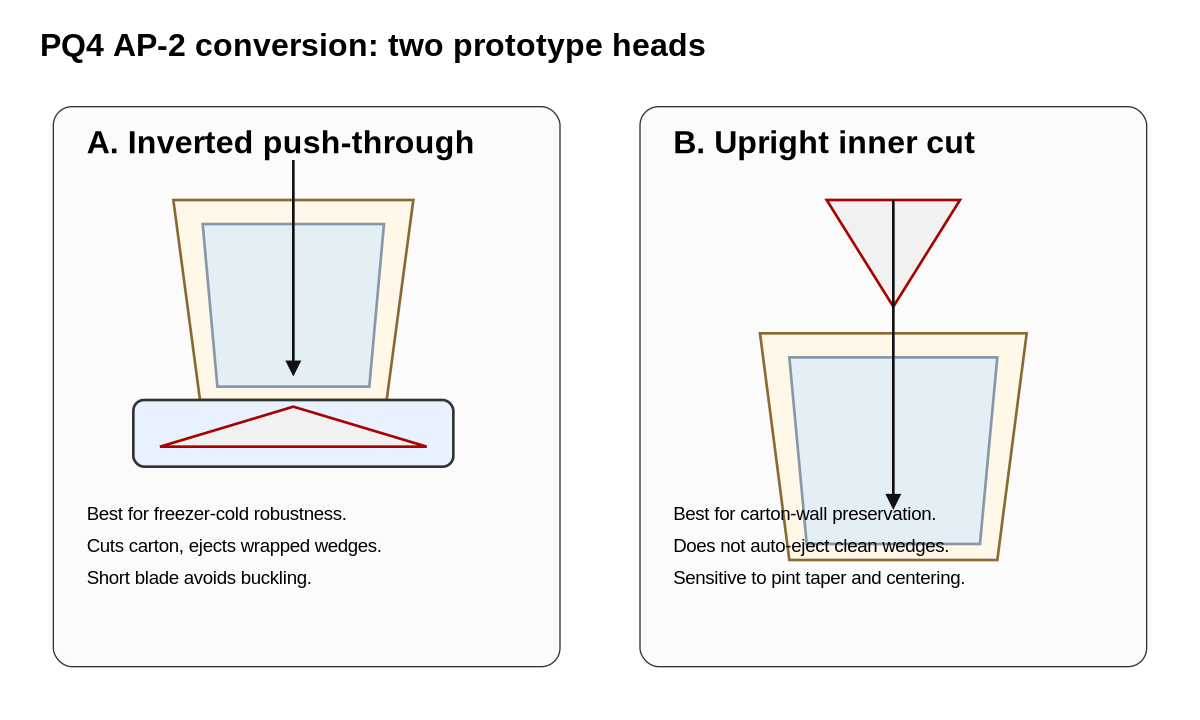
Lid off, pint loaded, pull the handle β the AP-2's force and 9-inch stroke do the cutting. Rev A ships two interchangeable heads with an honest tradeoff between them.
Wrapped wedges
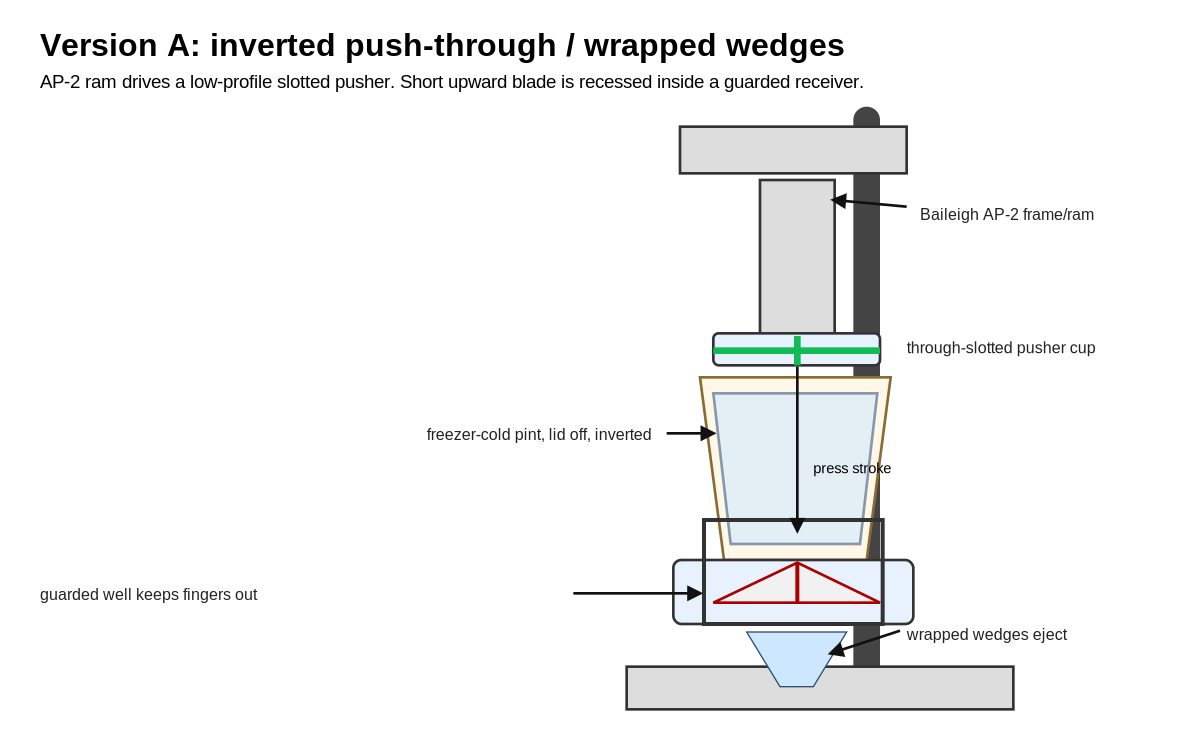
Inverted lid-off pint drops into a guarded receiver; the ram pushes it down through a short stationary cross blade. The carton is cut with the ice cream, so four peelable carton-backed wedges drop out. Short blade, low buckling risk, self-stripping, dramatic output.
Inner cut
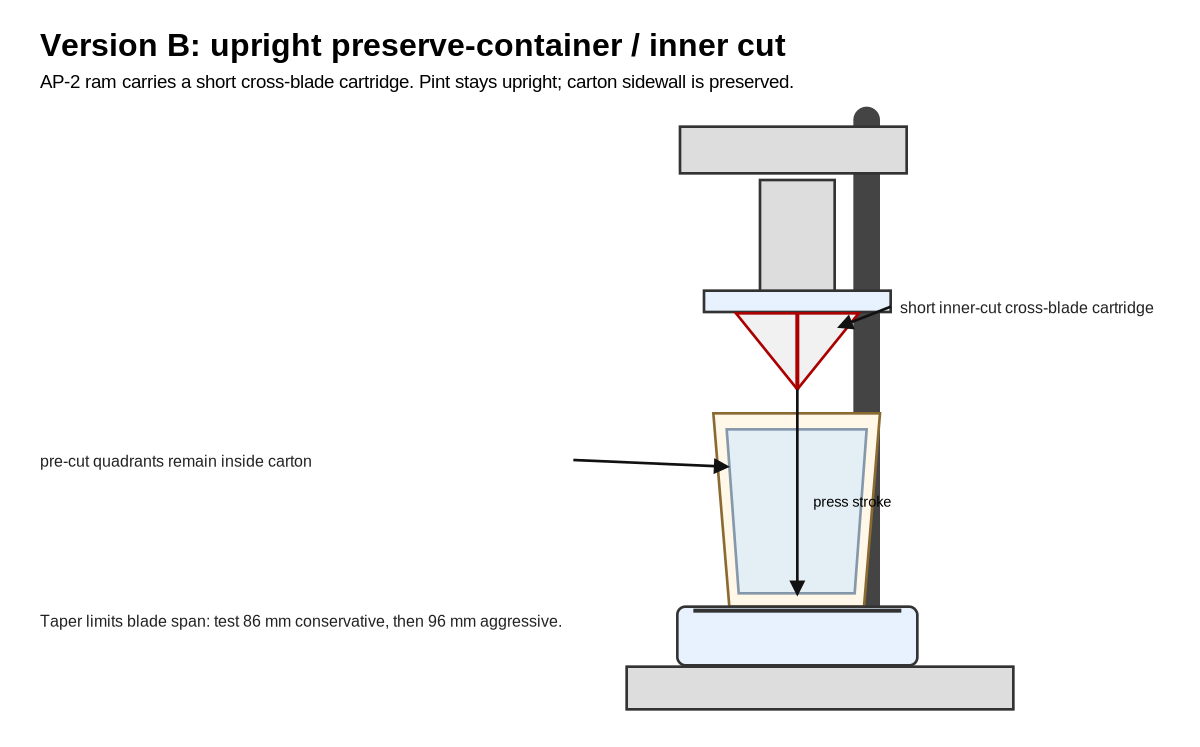
Pint stays upright in a centering collar; a short cross-blade cartridge descends into the ice cream, trying to leave the printed paperboard wall intact. Output is pre-cut quadrants inside the carton β cleaner food contact, but no automatic ejection.
"The test protocol treats this as an experiment, not theology. Let the dairy testify."
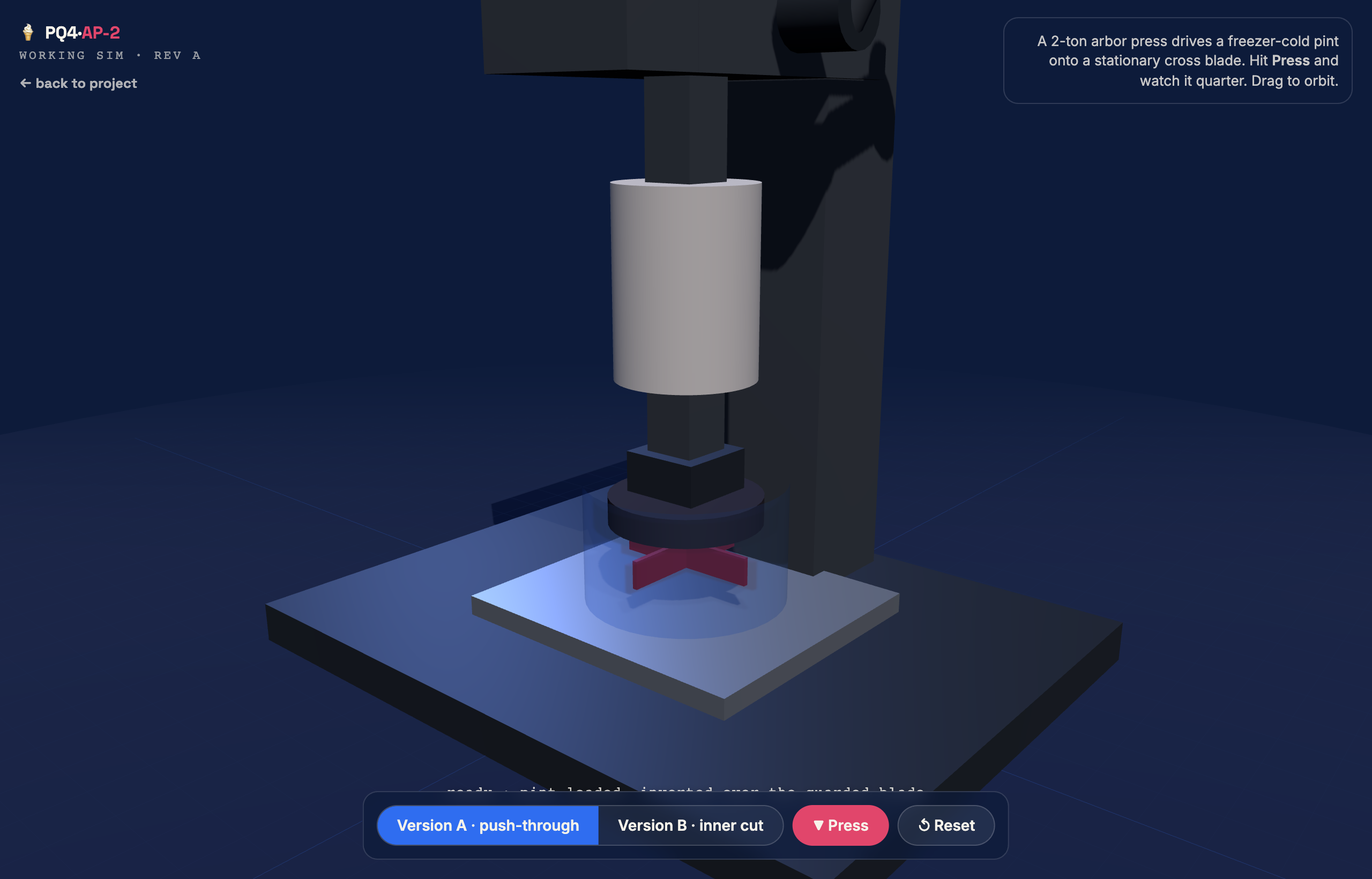
A live three.js model of the press in action β load a pint, hit Press, and watch the ram drive it onto the cross blade until four wedges split out. Toggle Version A / B and orbit to look around.
βΆ Launch the simulation
The whole kit hangs off one stock press: a Baileigh Industrial AP-2 (2-ton manual). Rev A adapts it without drilling the ram β everything clamps on and is match-drilled after the press is on the bench.
| Model | Baileigh AP-2 Β· BA9-1232699 |
| Capacity | 2 ton, manual |
| Throat | 5.375 in |
| Stroke | 9 in β the number that matters |
| Over table | 7.5 in β the constraint |
| Ram | 1.25 in square (31.75 mm) |
Stroke lets a short pusher drive a full pint through a fixed blade. Capacity-over-table is why the guard and pusher are deliberately low-profile. Verify your physical press before cutting anything that depends on mounting holes, ram position, or daylight.

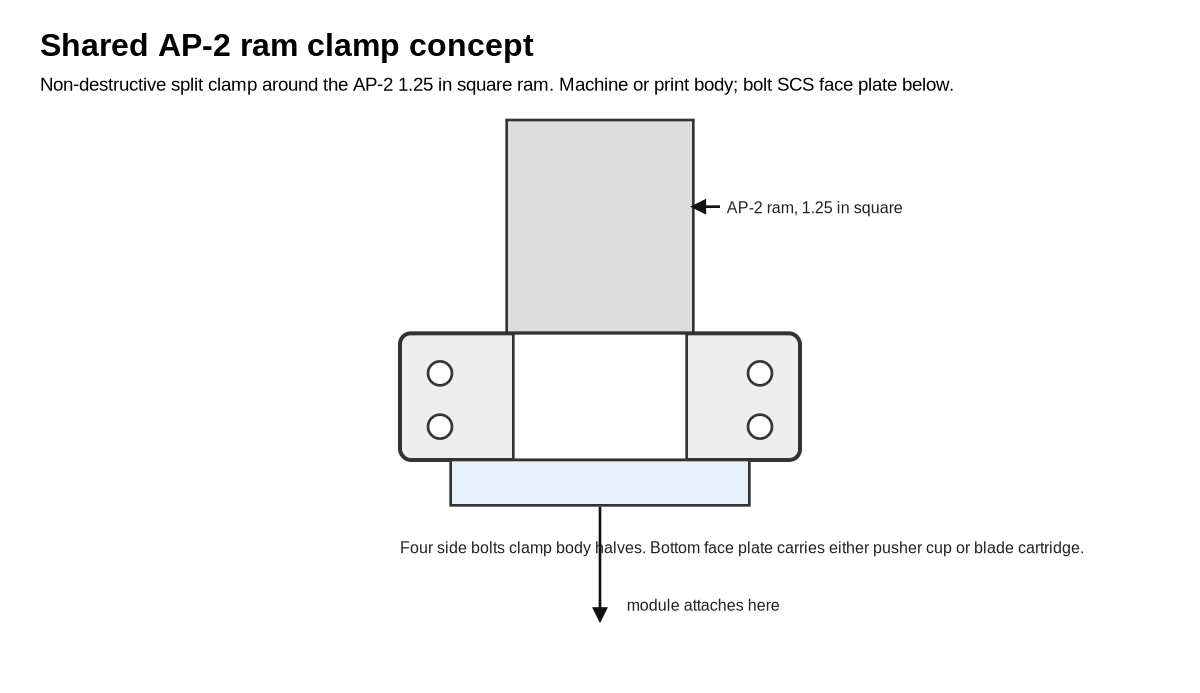
Two machined/printed halves grip the 1.25β³ square ram β do not drill it. Internal square pocket ~31.75 mm (measure your ram), four M6 / ΒΌ-20 side bolts. Best in 6061 aluminum; CF-nylon print only for low-force early tests.
A universal low-profile plate (165 Γ 140 mm), not an AP-2 hole-pattern replica. Set it on the table, align to the ram centerline, clamp, then match-drill or fixture after physical fit-up.
Version A must stay low: receiver rim 45β50 mm, blade tip ~30 mm, pusher 19β22 mm, pint ~112 mm. A tall stack eats the AP-2 daylight β dry-stack wood/plastic mockups before ordering metal.
A cold pint is not a citrus half. A thin blade reduces displacement but buckles and chips; a thick blunt wedge survives but demands force. Rev A's compromise leans on AP-2 leverage and short blade height.
"Do not chase a tiny razor blade. Tighter is not automatically better β ice cream, paperboard, and cold plastic do not reward watchmaking vanity."
| Blade stock | 304 stainless, 0.125 in / 3.18 mm |
| Edge | V / chevron β cut starts at center, grows outward |
| Finish | 20β30Β° bevel, polished lengthwise, passivated |
| Version A blade | 118 mm span, short stationary height |
| Version B families | 86 mm conservative Β· 96 mm aggressive |
| Cold assist | optional hot-water dip / heated-blade module |
A laser-cut blank is not a finished kitchen edge β the blade is a finishing process, not just a cutting one.
17 parts across three groups. Stainless in the food zone; aluminum/plastic for structure and guarding.
| PART | NAME | QTY | MATERIAL | THICK |
|---|---|---|---|---|
| COMMON | ||||
| PQ4-COM-001 | Universal module base plate | 1 | 304 SS / 6061 Al | 6.35 mm |
| PQ4-COM-002 | Ram-clamp bottom face plate | 1 | 6061 Al / 304 SS | 6.35 mm |
| VERSION A Β· INVERTED PUSH-THROUGH | ||||
| PQ4-INV-101 | Stationary blade strip A (top-slot) | 1 | 304 stainless | 3.18 mm |
| PQ4-INV-102 | Stationary blade strip B (bottom-slot) | 1 | 304 stainless | 3.18 mm |
| PQ4-INV-103 | Blade retainer disc | 1 | 304 stainless | 6.35 mm |
| PQ4-INV-104 | Receiver guard ring layer | 3 | HDPE / Delrin / PC | 6.35β12.7 mm |
| PQ4-INV-105 | Slotted ram pusher cup face | 1 | HDPE / Delrin | ~19 mm |
| PQ4-INV-106 | Collection tray divider (optional) | 1 | HDPE / Delrin | 3.18β6.35 mm |
| VERSION B Β· UPRIGHT PRESERVE-CONTAINER | ||||
| PQ4-UP-86/96-201/202 | Inner-cut blade strips (86 mm + 96 mm families) | 4 | 304 stainless | 3.18 mm |
| PQ4-UP-β¦-203 | Floating stripper plate | 2 | Delrin / HDPE | 6.35 mm |
| PQ4-UP-204 | Centering collar layer | 2 | HDPE / Delrin | 6.35β12.7 mm |
| PQ4-UP-205 | Sacrificial floor pad | 1 | HDPE / UHMW | 6.35 mm |
Full BOM with notes & file paths β bom/bom_revA.csv
Flat parts are organized one part per file as DXF (mm units, 1:1, closed contours). Upload DXFs individually β instant quoting takes DXF/DWG/EPS/AI + STEP, but not STL or raster.
SVGs in the repo are visual previews only β upload the DXFs (or STEP you derive in CAD).
SendCutSend cuts fast flat profiles β it does not deliver a sharpened, food-safe appliance. For hardened/sharpened blades, use a waterjet/knife-steel shop with proper heat-treat + passivation. Don't order a pile of beautiful wrong metal before testing with cardboard/acrylic mockups.
Exposed cutting edges + a 2-ton press. "The safe shape of the idea is not optional garnish."
Compare both heads on real freezer-cold pints "without pretending one anecdote is data."
| RUN | HEAD | BLADE | TARGET |
|---|---|---|---|
| A1 | Inverted | Room-temp | Wrapped wedges |
| A2 | Inverted | Hot-dipped | Wedges, lower force |
| B1 | Upright | Room-temp | Clean quadrants |
| B2 | Upright | Hot-dipped | Quadrants, less cracking |
Brand Β· pint dims Β· freezer temp + dwell Β· blade family Β· peak handle force (1β5) Β· wedge equality Β· face cleanliness Β· carton fiber transfer Β· ejection Β· cleanup time Β· near-misses Β· "how much the operator swore: 0β5 goblins."
A passes if it makes four separable wedge packets repeatably with no unsafe hand exposure or pusher/blade collision. B passes if it cuts clean internal quadrants with no visible paperboard scoring and the ice cream doesn't ride back up with the blade.
Geometry is scripted β scripts/generate_geometry.py (plain Python, writes DXF/SVG/PDF). Repo: github.com/siraustin/ice-cream